We are pleased to share a policy brief produced by Ahmed Yousuf Abdi, a current student in the SPIBES East Africa programme. The brief, titled Climate Change, Biodiversity Conservation and Livelihoods: Assessing Local Adaptation and Policy Responses in Geed Deeble Forest, Somaliland, was written as part of his MSc research and reflects his own findings and recommendations.
About the brief
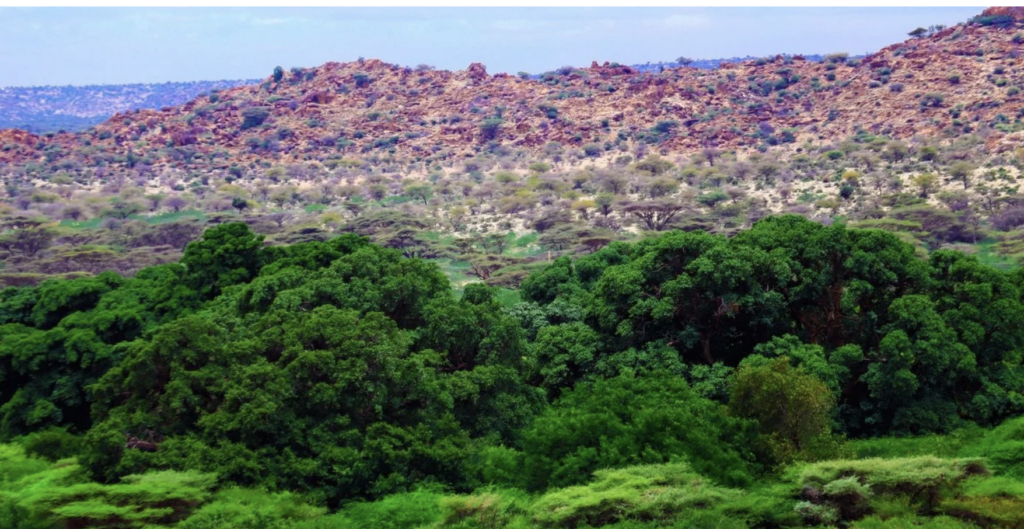
Geed Deeble Forest Reserve, located approximately 25 km north of Hargeisa in the semi-arid central highlands of northern Somaliland, covers nearly 5,868 hectares and serves as a critical water catchment area and biodiversity hotspot. The forest directly supports the livelihoods of agro-pastoral communities, farmers, and daily labourers. Yet rising temperatures, prolonged droughts, erratic rainfall, and growing environmental degradation are threatening both the forest’s ecological integrity and the communities that depend on it. Ahmed’s brief examines these pressures, assesses local adaptation strategies, and identifies gaps in existing policy responses.
Key findings
Ahmed’s research combined a 24-year NDVI analysis using Landsat satellite imagery with household surveys of 130 respondents across three livelihood groups- pastoralists, agro-pastoralists, and sedentary households- alongside focus group discussions and key informant interviews. The ecological data show a significant increase in vegetation greenness over the study period, with mean NDVI values rising from 0.113 in 2000 to 0.201 in 2024, and bare or degraded land declining from 93.89% to 10.75%. However, these improvements must be interpreted with caution: moderate and dense vegetation accounted for only 3.34% of the landscape in 2024, and part of the observed greening may reflect the spread of the invasive species Prosopis juliflora rather than genuine forest recovery.
The socioeconomic picture is equally concerning. Nearly half of respondents, 48.46%, reported no conservation policy interventions in their communities, and 69.23% rated existing interventions as having low or very low effectiveness. Climate impacts varied across livelihood groups, with agro-pastoralists experiencing the highest crop failure rates (40.8%) and pastoralists suffering the most severe livestock losses (39.2%). Across all groups, 73.1% reported declining forest-based livelihood resources, and 36.9% had resorted to migration as a coping strategy. Youth engagement in environmental decision-making was strikingly low, with 76.92% of respondents reporting no youth involvement — a significant governance gap.
Recommendations
Based on his findings, Ahmed calls for community-based adaptation approaches that combine local knowledge and traditional conservation practices, including the traditional seero system of protected community areas, with scientific methods. He recommends improving access to climate information, prioritising control of Prosopis juliflora and restoration of native vegetation, and expanding long-term ecological and socioeconomic monitoring using remote sensing. He also calls for traditional conservation systems to be formally integrated into governance frameworks.
You can download Ahmed’s full policy brief below: