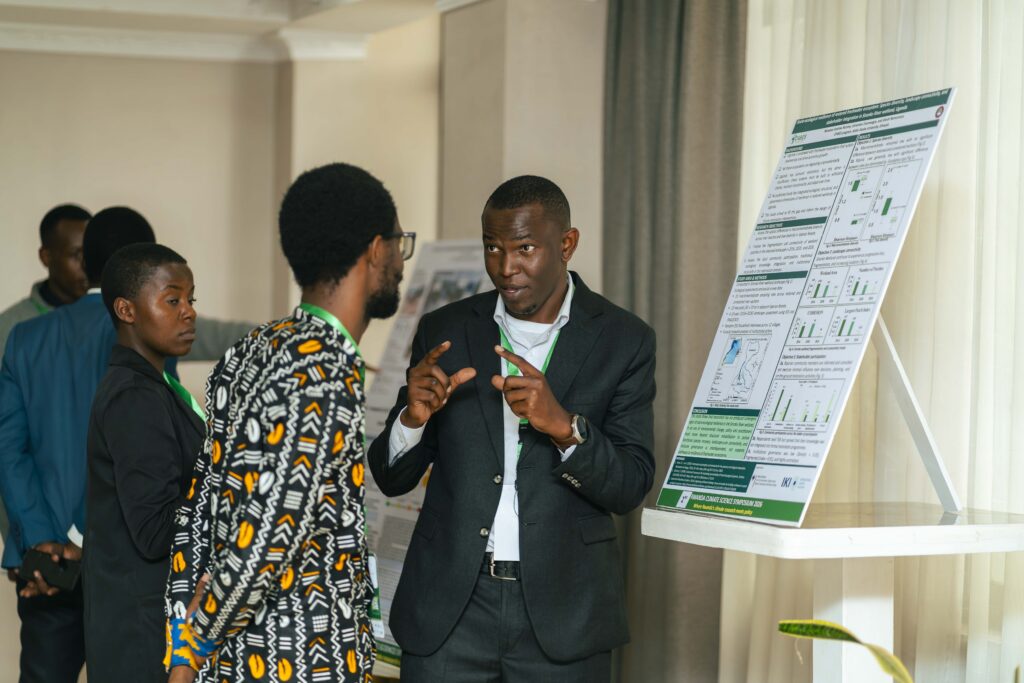
The CABES MSc programme in Managing Science-Policy-Practice Interfaces for Biodiversity and Ecosystem Services (SPIBES) trains students to produce scientific evidence, take part in science-policy platforms on biodiversity conservation, and communicate their findings to decision-makers. On 22–23 September 2026, recent graduate Andrew Remmy Muwaza did this at the 2nd Rwanda Climate Science Symposium in Kigali, held under the theme “Where Rwanda’s climate research meets policy.”
Andrew’s poster came out of his MSc thesis at Addis Ababa University. It asked whether restoration in the Sironko River wetland in eastern Uganda has made the ecosystem more resilient. Uganda has invested in restoring its freshwater ecosystems, but restoration that does not leave a system able to absorb shocks and adapt over time will not hold. No earlier study in Uganda had looked at the ecological, structural and governance sides of resilience in restored wetlands together.
The study combined field ecology with social research. Andrew sampled macroinvertebrates at 10 sites along restored and unrestored stretches of the river and surveyed trees in 15 riparian forest plots. He used GIS and FRAGSTATS to track how the wetland landscape changed between 2016 and 2026, interviewed 292 households across 12 villages, and carried out a social network analysis of the institutions involved in restoration.
The results show that restoration has not yet produced resilience. Macroinvertebrate diversity was low and did not differ between restored and unrestored sections. Tree diversity was also low, and riparian forests were dominated by eucalyptus. The wetland has continued to shrink and break into more isolated patches over the ten-year period, which limits the ability of species to move between patches and recolonise areas after local losses. Local residents reported being informed and consulted about restoration but having little influence over planning or on-the-ground decisions. Many hold traditional ecological knowledge that they said had not been taken into formal restoration programmes. The network of institutions involved was sparse, fragmented and highly centralised.
Andrew’s message to policymakers was that with warming set to exceed 1.5°C (UNEP, 2026), efforts to meet Target 2 of the Kunming-Montreal Global Biodiversity Framework “should therefore go beyond counting hectares: restoration must be ecologically functional and resilient to the climate shocks and human interferences.” In practice, this means treating species recovery, connectivity across the landscape and inclusive governance as linked parts of restoration planning rather than separate tasks.
Andrew’s thesis was supervised by Dr Isimemen Osemwegie and Prof. Sileshi Nemomissa. We thank GIZ Rwanda and the Rwanda Ministry of Environment for making space for early-career researchers at the symposium, and the International Climate Initiative (IKI) of the German Federal Ministry for the Environment, Climate Action, Nature Conservation and Nuclear Safety (BMUKN) for supporting CABES.
Click on the link below to see the poster in full: